Sarah’s growing concern for Dinah Singleton
Down Cemetery RoadSarah’s growing concern for Dinah Singleton begins with a memory too slight to seem important: a brief encounter on a towpath, where a small blonde child fed crusts to swans. After the explosion that destroys Dinah’s home, the memory returns with force. What changes is not simply Sarah’s knowledge of the child, but her sense of responsibility toward her: Dinah’s survival comes to feel like a bond that demands attention and action.
Recognition and the returning memory
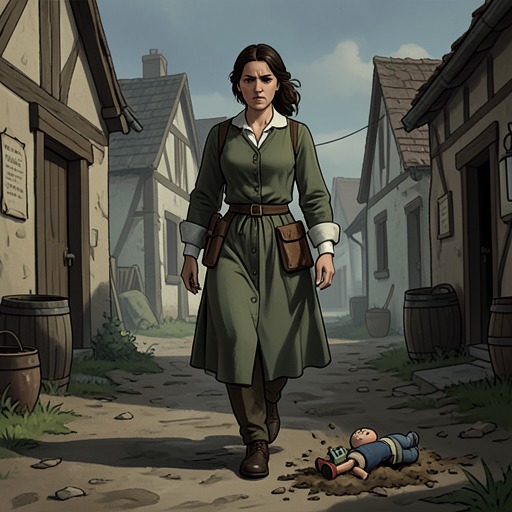
The connection first surfaces while Sarah is with Wigwam, whose tears and recollections bring the dead Maddie Singleton into the conversation. Sarah initially has only a hazy image of a woman and child. Wigwam identifies the child as Dinah, and Sarah recovers a particular scene: Dinah sitting on the towpath, throwing bread to the swans, her hair in bunches, her clothes grubby, and bright yellow jellies on her feet. Sarah remembers that Dinah had pointed out the swans. The meeting happened only once, and the mother made little impression on her; the child, by contrast, becomes newly vivid in retrospect.
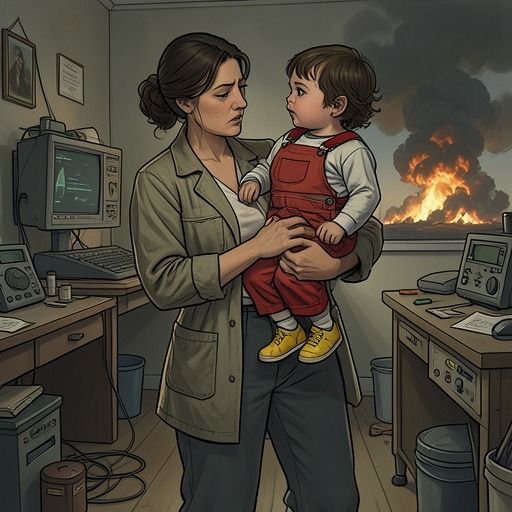
That shift is sharpened by Sarah’s earlier indifference to children. She considers them dull at one age and unbearable at another, and regards Wigwam’s children as especially irritating. Yet after the bomb, she cannot stop picturing Dinah asleep as the blast tore through her house. In Sarah’s mind, Dinah wears red overalls and yellow jellies, the same details that attach her to the remembered towpath scene. The image does not erase Sarah’s settled opinions; it exposes the limits of their hold over her. A particular child has become harder to dismiss than children as an abstract category.
Survival as a bond
The image that most disturbs Sarah is a wardrobe falling around Dinah as the blast rips through the house. Its doors flap open, and the wardrobe becomes, in Sarah’s imagination, a protective coffin: an enclosure that shields the child from the destruction. Sarah reads the survival as a kind of instant resurrection, but that thought immediately raises a harder question about what life remains for Dinah. Thomas Singleton died before his daughter was born, and her mother has now died as well. Survival has left Dinah orphaned, not untouched by loss.
Sarah’s concern is intensified by the resemblance she sees between their experiences. She, too, is a survivor; Dinah has come through the fire, though the circumstances of their ordeals are different. Sarah thinks of survival as a shared gift, almost a talisman, and the parallel makes Dinah’s fate personally legible to her. The child is no longer only the survivor of a nearby explosion. She becomes the person through whom Sarah confronts the fragile, arbitrary line between being spared and being safe. The wardrobe’s protection cannot answer what comes after the blast, and that uncertainty keeps the child in Sarah’s thoughts.
From unease to deliberate action
Sarah’s response becomes concrete when she goes to the hospital to ask for Dinah. At Reception, amid three ringing telephones and a short queue, she explains that she wants to see and speak to the little girl brought in after an explosion. Asked whether she is a relative, Sarah first identifies herself as a neighbour, then adds that she is a friend. The adjustment gives voice to a concern that has outgrown the thinness of her actual acquaintance with Dinah: they have met only once, but Sarah no longer experiences that meeting as incidental.
She wants to know Dinah’s condition and to establish that she has not merely survived the blast but will continue to survive. Sarah’s own fear of hospitals and their institutional anonymity colors that wish. She knows how easily a person can become just another patient, and the possibility that Dinah might be absorbed into that anonymity troubles her, even though Sarah recognizes that the child’s fate is not technically her business. Her care is therefore neither a claim of family intimacy nor a simple extension of neighbourliness. It begins in memory, gathers urgency through imagined vulnerability, and becomes an insistence on knowing what happened next.
A choice that persists
The concern alters Sarah’s priorities beyond the hospital visit. She does not tell Mark Trafford that she is looking for Dinah, in part because she expects the decision to be used against her in their disagreement about having children. She gives her maiden name at Reception, an unusual choice for her, and recognizes that keeping the search private protects her from that pressure. The episode ties her attention to Dinah to a conflict in Sarah’s own life, but it does not reduce the child to a symbol in that conflict: Sarah wants to know Dinah’s actual condition and future.
As people tell her to stop looking, Sarah decides that continuing is a way of maintaining control over her own choices. She resolves to pay Joe Silvermann’s bill herself, even if she has to take bar work, and keeps the possibility of having a child separate from the immediate decision to continue the search. Her position is not a sudden conversion to motherhood; she is explicit that any such decision would come in her own time. The distinction matters. Dinah’s importance is that Sarah cares about this particular child without treating that care as proof that she must accept someone else’s expectations for her life.
The danger surrounding Dinah is not merely Sarah’s private imagining. When Howard asks about the child after the bombing, he is told she is fine; Howard identifies Axel Crane as responsible and asks what he might do next. This does not resolve what Sarah can know or secure for Dinah, but it confirms that the explosion belongs to a wider and continuing threat. Against that backdrop, Sarah’s determination to follow the story to its conclusion has practical weight. Her relationship with Dinah is formed at a distance, through memory, concern, and pursuit, yet it becomes one of the clearest challenges to Sarah’s habitual detachment: the child she scarcely noticed once is now someone whose survival she refuses to regard as someone else’s problem.